
All Important Articles of Indian Constitution
All Important Articles of Indian Constitution
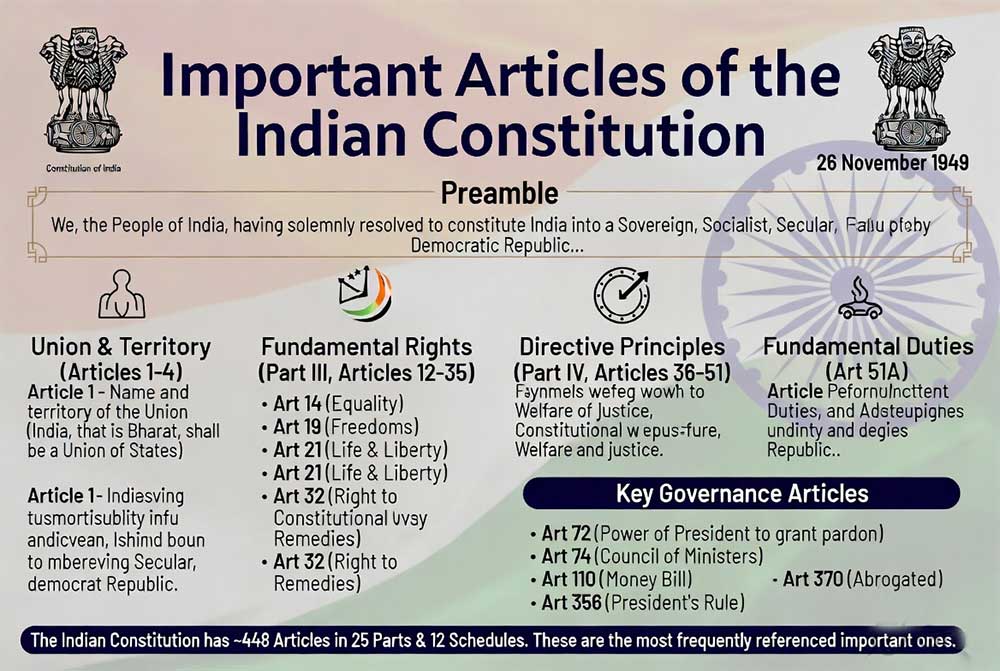
The Indian Constitution is the longest written constitution in the world. It originally had 395 articles in 22 parts and 8 schedules. As of now, it has around 448 articles in 25 parts and 12 schedules
1. Parts of the Constitution (Overview)
- Part I: Union and its Territory (Articles 1–4)
- Part II: Citizenship (Articles 5–11)
- Part III: Fundamental Rights (Articles 12–35)
- Part IV: Directive Principles of State Policy (DPSP) (Articles 36–51)
- Part IV-A: Fundamental Duties (Article 51A)
- Part V: The Union (Articles 52–151) — President, Parliament, etc.
- Part VI: The States (Articles 152–237)
- Part IX: Panchayats (Articles 243–243O)
- Part IX-A: Municipalities (Articles 243P–243ZG)
- Part XV: Elections (Articles 324–329A)
- Part XVIII: Emergency Provisions (Articles 352–360)
- Part XX: Amendment of the Constitution (Article 368)
2. Most Important Articles (Themed List)
Union and Territory + Citizenship
- Article 1: Name and territory of the Union (India, that is Bharat, is a Union of States).
- Article 2: Admission or establishment of new States.
- Article 3: Formation of new States and alteration of areas, boundaries, or names of existing States.
- Article 5–11: Citizenship provisions (at commencement and Parliament’s power to regulate).
Fundamental Rights (Part III) — Heart of the Constitution
- Article 12: Definition of “State” (for enforcement of FRs).
- Article 13: Laws inconsistent with or in derogation of Fundamental Rights (judicial review).
- Article 14: Equality before the law and equal protection of laws.
- Article 15: Prohibition of discrimination on grounds of religion, race, caste, sex, or place of birth.
- Article 16: Equality of opportunity in matters of public employment.
- Article 17: Abolition of Untouchability.
- Article 19: Protection of certain rights (freedom of speech & expression, assembly, association, movement, residence, profession).
- Article 20: Protection in respect of conviction for offences (no ex-post facto laws, double jeopardy, self-incrimination).
- Article 21: Protection of life and personal liberty (expanded by judiciary to include right to privacy, dignity, livelihood, etc.).
- Article 21A: Right to Education (added by 86th Amendment).
- Article 22: Protection against arrest and detention.
- Article 23–24: Right against Exploitation (trafficking, forced labour, child labour).
- Article 25–28: Freedom of Religion.
- Article 29–30: Cultural and Educational Rights (minorities).
- Article 32: Right to Constitutional Remedies (heart and soul of the Constitution; writs in Supreme Court).
Note: Right to Property was originally Article 31 (FR); now it is a legal right under Article 300A.
Directive Principles of State Policy (DPSP) — Non-justiciable but fundamental to governance
- Article 38: Secure social order for welfare of people.
- Article 39: Certain principles of policy (equal pay, distribution of resources, etc.).
- Article 39A: Equal justice and free legal aid.
- Article 40: Organisation of village panchayats.
- Article 43: Living wage for workers.
- Article 44: Uniform Civil Code.
- Article 45: Provision for early childhood care and education (now linked to 21A).
- Article 46: Promotion of educational and economic interests of SCs, STs, and weaker sections.
- Article 48A: Protection of environment and wildlife.
Fundamental Duties (Article 51A)
Added by 42nd Amendment (11 duties — respect Constitution, promote harmony, protect environment, etc.).
The Union (Executive, Legislature, Judiciary)
- Article 52–62: President of India (election, qualifications, impeachment — Article 61).
- Article 63–71: Vice-President.
- Article 72: Pardoning powers of President.
- Article 74: Council of Ministers to aid and advise the President (Prime Minister is real executive).
- Article 76: Attorney General of India.
- Article 79–122: Parliament (composition — 80 & 81 for Rajya Sabha & Lok Sabha, sessions, money bills — 110, ordinances — 123).
- Article 124–147: Supreme Court (establishment, jurisdiction, etc.).
- Article 148–151: Comptroller and Auditor General (CAG).
States
- Article 153–167: Governor and State Executive.
- Article 213: Governor’s ordinance-making power.
- Article 214–237: High Courts.
Local Governance
- Article 243–243O: Panchayati Raj (73rd Amendment).
- Article 243P–243ZG: Municipalities (74th Amendment).
Elections & Constitutional Bodies
- Article 324: Election Commission of India (superintendence, direction, control of elections).
- Article 326: Adult suffrage.
- Article 338: National Commission for Scheduled Castes.
- Article 340: Commission for backward classes.
Emergency & Amendment
- Article 352: National Emergency (war/external aggression/army rebellion).
- Article 356: President’s Rule (failure of constitutional machinery in State).
- Article 360: Financial Emergency.
- Article 368: Power of Parliament to amend the Constitution (basic structure doctrine applies).
Other Key Articles
- Article 280: Finance Commission.
- Article 300A: Right to Property (legal right).
- Article 343: Official language of the Union (Hindi).
- Article 370 (abrogated): Special provisions for Jammu & Kashmir (historically important).