
Trinatha Mela Book PDF
Trinatha Mela Book PDF
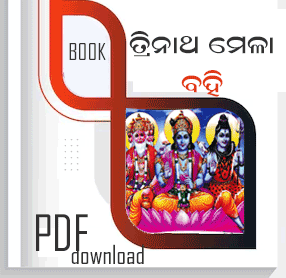
Trinath means the Lord of the Three Brahma, Vishnu, and Maheshwara (Shiva) together. In Odisha, Assam, and Tripura, Trinath is not worshipped in a big temple ritual, but through a simple folk fair called Trinath Mela, based on an old oral story.
Different regions tell it slightly differently. This is the popular version from the Barak Valley region.
The Voice Under the Banyan Tree
One afternoon, a Brahmin was walking to the market. On the way stood a huge banyan tree.
As he passed it, a voice came from nowhere:
“Thakur, stop! Look below in front of you.”
The Brahmin looked down. Three shining coins lay on the white sand.
The voice said: “Take these coins and bring oil, paan (betel leaf), and ganja — one paisa worth of each.”
The Brahmin took the coins, confused, and went to the market. He bought things for himself, but forgot what the voice had asked for. Suddenly he kept stumbling on a road he knew perfectly well.
He realised his mistake, went back, and bought the paan and ganja. For the oil, he had no bottle, so he spread a corner of his dhoti and asked the grocer to pour it there.
The grocer thought he had gone mad. He wiped his measuring mug and pretended to give him oil.
But as the Brahmin walked away, the grocer shouted, “Stop, Thakurmashai, forgive me! You must be a god!” His whole can of oil had suddenly become empty.
This time the grocer measured the oil honestly and poured it into the dhoti.
The Brahmin said, “I am not a god. Perhaps the one I am taking this for is a god.”
The First Trinath Mela
Near the banyan tree, the Brahmin said, “Hey god, whoever you are, take your goods.”
The voice replied: “Take them to your home and organise Trinath Mela.”
“How is it organised?” asked the Brahmin.
“Light a diya with the oil. Offer paan and ganja, and sing songs in praise of Trinatha.”
On his way home, miracles began to happen. His lost cow, which he had searched for for days, was suddenly grazing by the roadside. When he reached home, his son — who had never spoken before — shouted, “See Maa, Baba has found our cow!”
His wife, who had never called her mother-in-law “Maa”, suddenly did so. The whole family felt a god had blessed them.
That evening they lit the diya, offered paan and ganja, invited neighbours, and sang devotional songs. That was the first Trinath Mela.
The Guru Learns Humility
Meanwhile, a guru was travelling by boat on a nearby river. He wanted fire for his hukka, so he sent his boatman to get fire from the house where the singing was coming from.
The people were so absorbed in singing, they did not listen to the boatman.
Feeling insulted, the guru himself rushed there, kicked their offerings, took fire from the diya, and returned in anger.
But when he reached home, he found his son dead.
He realised his mistake he had disrespected a worship of God. He hurried back and begged, “Tell me how I can atone. I have lost my son.”
The poor Brahmin said, “Take the sacred ash of the ganja, massage your son’s body with it. Your son will wake up again. And don’t forget to organise Trinath Mela if he lives.”
The guru did so. His son came back to life. He too organised a grand Trinath Mela at his home.