
What Did Ancient Humans Actually Do All Day?
What Did Ancient Humans Actually Do All Day?
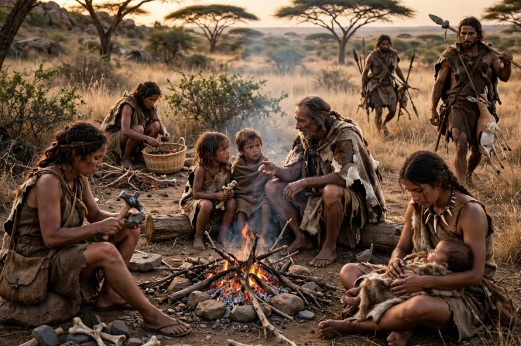
The Modern Trap vs. Ancient Freedom
This morning, a machine screamed at you until you woke up. You silenced it. And from that second, your day was already decided where you had to be, what you had to finish, how many hours belong to someone else.
Tonight, before you sleep, you’ll set that same machine to scream at you again.
Now rewind 50,000 years. A man wakes up in the morning light with no alarm, no schedule, and nowhere he has to be. He owns a spear, two animal hides, and a fire. He sits up, stretches, and asks himself a question you have never once been free enough to ask: What should I do today?
Your brain is probably fighting this already. It’s telling you ancient life was brutal, short, and desperate—that every second was survival. For centuries, that was the official story. But the proof that it’s wrong was lying buried in the ground the entire time. And when scientists finally dug it up, it flipped everything upside down.
The Skeletal Evidence: Your Bones Keep a Diary
Somewhere in the Middle East, archaeologists pulled two human skeletons from the same region. They lived a few thousand years apart—close enough to compare, far enough to come from completely different worlds.
The first skeleton was tall. The bones were thick and strong. The teeth were worn but healthy, almost no cavities. The joints were clean. This was a body that ate well, moved in varied ways, and never got ground down by one repeated motion.
The second skeleton told a harder story. The teeth were full of cavities. The spine showed arthritis the specific damage you get from bending and grinding through the same motion thousands of times, year after year. This person died younger.
So which one was which? Most people guess the tall, healthy skeleton was the farmer with tools and stored food. The wrecked one must be the caveman, right?
It’s the opposite. The strong skeleton belonged to the hunter-gatherer. The wrecked one belonged to the farmer the person from the era we call progress.
This isn’t one weird pair of bones. Archaeologists have run this comparison at sites all over the world. Wherever farming replaced hunting and gathering, the same pattern shows up in the ground: generations got shorter, teeth rotted, spines wore down, and lives ended earlier.
Your skeleton is a diary. It records how hard you worked, how well you ate, how your body was used—and it holds that record for thousands of years. And the diaries say the people with nothing but spears were living easier lives than the people who came after them with farms, storage, and villages.
The 17-Hour Work Week
In 1963, an anthropologist named Richard Lee walked into the Kalahari Desert on the edge of Botswana—one of the harshest places on Earth a human being can live. He went there to study the Ju/’hoansi, one of the last groups still living the old way: hunting animals and gathering plants with no farms and no stores.
Lee expected to find misery. That was the official story in every textbook—that life before farming meant working every daylight hour just to barely survive. But instead of assuming it, he decided to count it. He followed people around with a notebook and a stopwatch, recording how they spent every single hour, day after day, for weeks.
Lee came back with a number that nobody believed.
These people were spending about 17 hours a week getting food. Not 17 hours a day—17 hours across the entire week. That’s about two and a half days of work. Every hour after that belonged to them.
For comparison, you’ll cross 17 hours of work by Wednesday afternoon.
Maybe the Ju/’hoansi were just one lucky group, right? Scientists had that doubt too. So they ran the same count on other groups still living the old way—the Hadza in Tanzania, the Ache in Paraguay, the Martu in Australia. Three groups, three continents, and every single time the answer came back between 15 and 20 hours a week. That was the full cost of staying alive.
The Secret of Persistence Hunting
Real hunting looks nothing like the movies. You never chase the animal because it’s faster than you—it always will be. Instead, you follow it at a steady walking pace for hours.
Your body can sweat and cool itself while it moves. The animal can’t. So it keeps sprinting, keeps overheating, keeps getting weaker until it finally collapses and you walk up to it. You were never the fastest thing out there. You were the only thing that never has to stop.
The hunt takes the whole day, and it’s the hardest work this life asks of you. But one good hunt feeds the camp for days. So tomorrow, the free time starts again.
How They Spent Their Free Time
Art, Beauty, and the First Jewelry
It’s afternoon, and the camp has slowed down. People sit in the shade and talk. They play with the kids and groom each other, picking through hair while conversation drifts.
Next to you, someone is drilling tiny holes through seashells to string into a necklace. Someone else is carving a design into a piece of bone a design with no purpose at all except to look good.
This isn’t a guess about how they filled their time. At Blombos Cave in South Africa, archaeologists found shell beads over 70,000 years old small sea snail shells with holes carefully drilled through them, made to be worn. The coast was a long walk from where these people lived. Someone made that trip, collected the shells, carried them home, and then sat for hours drilling holes with stone tools just to make something beautiful.
In 2008, in a cave in Germany, researchers dug up a flute carved from a vulture’s wing bone. It’s 40,000 years old, with five finger holes spaced for actual musical notes. Someone in the Ice Age understood music well enough to build an instrument and someone had enough free time to learn to play it.
Social Insurance: Your Relationships Are Your Bank Account
This world has no money, no police, and no courts. So what actually keeps you alive when your hunt fails, when you get sick, when you break your leg and can’t walk for a month?
The answer is other people. That’s the entire safety net.
If people like you, they feed you when you have nothing. If they don’t like you, nobody owes you anything—and you starve. So all those lazy afternoon hours of talking and joking and grooming were actually an investment in the only insurance this world has.
The anthropologist James Suzman found that Ju/’hoansi adults spend around 6 hours every single day on pure social time. Because in this world, your relationships are your bank account, your hospital, and your pension all at once.
The Night Shift: Where Culture Was Born
The sun goes down, and here’s where it gets really interesting. The best hours of the day haven’t even started yet.
In 2014, an anthropologist named Polly Wiessner published a study that might explain where human culture itself comes from. She had recordings of Ju/’hoansi conversations collected across decades and sorted them by one simple thing: was it said during the day or at night?
Daytime talk turned out to be practical—where the animal tracks were, which plants were ready to gather, who wasn’t sharing fairly. Basically logistics and gossip.
But at night, around the fire, the talking changed completely. 81% of firelight conversation turned into stories. People told myths about how the world began, tales of ancestors who did impossible things, and jokes that ran long into the dark.
Notice what kind of stories these are. Gods and spirits, the past and the future. None of that comes out of a scared, hungry mind. Those stories only show up when your stomach is full and your body is safe.
The fire was doing more than cooking food and keeping predators away. It created the first hours in human history where the mind was completely free. Wiessner argued that this is exactly where culture was born—not in the middle of the work, but in the quiet hours after it.
The Lost Art of Two Sleeps
When the fire burned low, even sleep worked differently. Before artificial light existed, humans didn’t sleep in one long block.
Historical records and modern sleep experiments both show the same pattern. People slept about four hours, then woke up for an hour or two in the middle of the night. They stayed calm in that darkness, thinking or talking quietly, until sleep came back for another four hours.
That quiet hour in the middle was completely normal for thousands of generations. Today, you wake up at 2:00 a.m. and call it insomnia. Your body might just be doing the oldest thing it knows.
The Farming Trap: How Your Time Disappeared
So now you’ve seen the whole picture. Food took a few hours. People took the afternoon. Stories took the night. Sleep came in two calm halves. That was the human schedule for hundreds of thousands of years.
Then about 10,000 years ago, somebody planted a seed—and that’s the moment your time started disappearing.
It happened in the Middle East, in a region called the Fertile Crescent, when humans started planting grain and keeping animals instead of hunting and gathering. On paper, farming sounds like a massive upgrade. You get more food, you get control, and you never have to follow an antelope for six hours again.
But farming is a trap. Here’s exactly how it snaps shut:
Farming produces more food. More food means more babies survive. The population grows. A bigger population needs more food. So you plant more fields. More fields means more work. And then the lock clicks.
Once your group is too big to feed by hunting and gathering, the old life can’t carry you anymore. You can never go back. You’re in permanently—and so is every generation born after you.
The workload explodes. Now there’s plowing, planting, weeding, harvesting, storing, and guarding it all—season after season, forever. Remember that second skeleton from the beginning, the one with the rotten teeth and the worn-out spine who died young? That skeleton is what this new life did to people. The first farmers worked harder and lived worse than the hunter-gatherers before them. And they couldn’t leave.
The trap kept tightening. Big farming villages produced specialists—potters, tool makers, weavers. Specialists needed trade, and trade built cities. Then cities brought soldiers, priests, and tax collectors. And eventually, they brought a brand new idea in human history: for the first time ever, your hours could belong to someone else. Sold off in exchange for food you no longer knew how to find on your own.
Nobody stole your time in one dramatic night. It was traded away slowly, one generation at a time, in a deal that no one alive today ever got the chance to refuse.
The Finish Line You Were Born On
The alarm that screamed at you this morning is just the latest payment.
For hundreds of thousands of years, humans worked 15 to 20 hours a week—and the skeletons in the ground prove it. The afternoons went into craft and beauty and the relationships that kept everyone alive. The nights went into firelight stories, where culture itself was born. And sleep came in two calm halves.
Then farming arrived, the population trap locked behind us, and step by step, our hours stopped being ours.
Today, you’ll spend about 90,000 hours of your life working. You make art only if there’s anything left of you after your job. They made art in the middle of an ordinary afternoon. You network for career advantage. They spent six hours a day with people they loved, and it counted as survival.
You chase success, savings, retirement some finish line where you finally get your time back. They were already standing on that finish line. They were born on it.
Every morning they woke up with no alarm and no schedule. And they asked themselves the one question you have never been free enough to ask.
You are working your entire existence to someday retire into that life. They lived it from their first day to their last.
And they would find it very strange that you traded it all away for a screaming alarm and a promise.