
Mohini Ekadashi Vrat Katha
Here is the Mohini Ekadashi Vrat Katha (story) in English, drawn from traditional scriptures like the Padma Purana. It is narrated in a dialogue format, beginning with Lord Krishna speaking to Yudhishthira (or in some versions, Sage Vasishtha to Lord Rama), and includes the main legend of redemption through the fast.
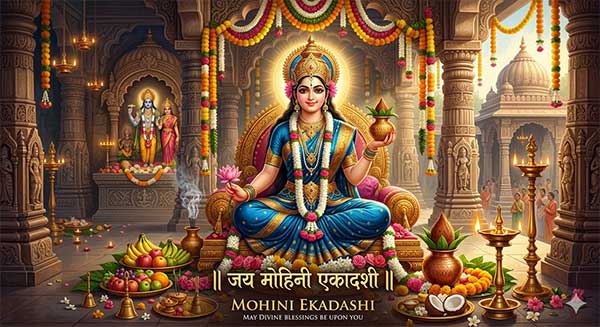
Mohini Ekadashi Vrat Katha
Once, Yudhishthira Maharaja asked Lord Sri Krishna: “O Janardana! What is the name of the Ekadashi that occurs during the bright fortnight (Shukla Paksha) of the month of Vaishakha (April-May)? What are its merits, and what is the proper way to observe it? Please narrate all these details to me.”
Lord Sri Krishna replied: “O blessed son of Kunti (or Dharma), I shall now describe to you what Sage Vasishtha once told Lord Ramachandra. Please listen attentively.
After the abduction of Sita, Lord Rama was greatly distressed by separation from her. He approached his guru, Sage Vasishtha, and said: “O great sage! I have suffered immense grief and sorrow. Please tell me about the best fasting day that can destroy all sins and alleviate all kinds of suffering, so that my pain may end and benefit all humanity.”
Sage Vasishtha replied: “O Lord Rama, whose intelligence is so pure, simply remembering Your name purifies a person. Yet, for the welfare of all, I shall describe this sacred fast. In the bright fortnight of the month of Vaishakha, there occurs an Ekadashi known as Mohini Ekadashi. It is supreme and capable of destroying even the darkest illusions and the heaviest sins (as vast as Mount Sumeru or Meru). Observing this fast liberates one from the entanglements of material attachment and misery. There is no better fast in the three worlds.”
Sage Vasishtha then narrated the following story:
In ancient times, on the beautiful banks of the Saraswati River, there stood a prosperous city called Bhadravati. It was ruled by a noble and truthful king named Dyutiman (or Dhritiman), born in the Chandravanshi (lunar) dynasty. In the same city lived a wealthy and pious merchant named Dhanapal (or Dhanapala), a great devotee of Lord Vishnu. He was known for his charitable works — digging wells, ponds, lakes, gardens, shelters, and temples for the benefit of the citizens.
Dhanapal had five sons: Sumana, Dyutiman, Medhavi, Sukriti, and the youngest, Dhrishthabuddhi (also called Dhristabuddhi). Unfortunately, the youngest son was extremely sinful. He indulged in vices such as gambling, drinking alcohol, eating forbidden foods, illicit relationships with courtesans (prostitutes), and other immoral acts. He disrespected demigods, Brahmins, elders, and guests. He squandered his father’s wealth recklessly on these sinful pleasures.
One day, Dhanapal saw his son walking arm-in-arm with a known courtesan in the street. Enraged by this public misconduct, the father, along with his other sons and relatives, kicked Dhrishthabuddhi out of the house and disowned him.
Now destitute, Dhrishthabuddhi sold his ornaments and clothes to survive. When his money ran out, even his so-called friends and the courtesans abandoned him, insulting him for his poverty. Overwhelmed by hunger, thirst, and anxiety, he turned to stealing. The king’s constables caught him several times, but initially released him out of respect for his father’s reputation. Eventually, tired of his repeated offenses, they arrested him, beat him, handcuffed him, and expelled him from the kingdom after severe punishment.
Dhrishthabuddhi fled into the dense forest. There, suffering greatly from hunger and thirst, he survived by hunting and killing animals and birds (deer, boars, lions, wolves, peacocks, doves, etc.) for food. His sins continued to accumulate, and he remained miserable.
One day, during the month of Vaishakha, by the force of some residual merit from his past, he wandered near the sacred ashram of the great sage Kaundinya Muni. The sage had just bathed in the Ganges River, and water droplets were still falling from his wet clothes. By divine grace, a few drops of this holy water touched Dhrishthabuddhi. Instantly, some of his ignorance lifted, and his heavy burden of sins was partially reduced. Feeling a spark of hope, he approached the sage with folded hands, offered obeisances, and prayed:
“O great Brahmin and sage! I have committed countless sins in my life, making me poor and wretched. Please be merciful and tell me a simple atonement or fast that I can perform without much effort or expense, so that I may be freed from my sins.”
The compassionate sage Kaundinya replied: “O son, listen carefully. In the bright fortnight of this very month of Vaishakha, there occurs the sacred Mohini Ekadashi. By observing a complete fast on this day with faith and devotion to Lord Hari (Vishnu), even sins as massive as Mount Sumeru are nullified. This fast will free you from all your remaining sinful reactions and grant you liberation.”
Dhrishthabuddhi was overjoyed. He faithfully observed the Mohini Ekadashi vrat exactly as instructed by the sage — with full devotion, fasting completely (without grains, and ideally without water in strict observance, though rules may vary by tradition), and engaging in Vishnu worship.
By the power of this Ekadashi, all his sins were completely destroyed. He became pure and sinless. After his death, he attained a beautiful transcendental form and ascended to Vaikuntha (the abode of Lord Vishnu), riding on the divine carrier Garuda, free from all obstacles and sufferings.
Lord Krishna concluded: “O Yudhishthira, the fast of Mohini Ekadashi removes the darkest attachments and illusions of material existence. There is no better fast day in all the three worlds. Even hearing or reading its glories bestows merit equal to donating one thousand cows in charity. Observing it with devotion grants peace, prosperity, and ultimately salvation. Those who keep this fast are freed from sins of many lifetimes and attain the blessings of Lord Vishnu.”
Significance
Mohini Ekadashi is observed in the Shukla Paksha (waxing phase) of Vaishakha month. It is believed to destroy sins, remove delusions (moha), and bestow Vishnu’s grace. Devotees worship Lord Vishnu (often as Purushottam or in His Mohini form related to the Samudra Manthan legend), chant His names, and listen to or read this katha.
Note on observance (general guidance):
- Fast from sunrise on Ekadashi to sunrise on Dwadashi (next day).
- Avoid grains, beans, and certain foods; some observe a strict waterless fast.
- Break the fast (Parana) on Dwadashi after sunrise, ideally with simple sattvic food.
- Perform Vishnu puja, offer flowers, fruits, and tulsi leaves.
-
Mohini Ekadashi 2026 Date
- Vrat Date: Monday, 27 April 2026 (Shukla Paksha Ekadashi of Vaishakha month).
- Ekadashi Tithi Begins: 26 April 2026 evening (approx. 6:06 PM).
- Ekadashi Tithi Ends: 27 April 2026 evening (approx. 6:15 PM).
- Parana (Breaking the Fast): On 28 April 2026 morning (typical window: around 5:43 AM to 8:21 AM
Benefits (as per scriptures)
Observing Mohini Ekadashi with faith destroys sins accumulated over many lifetimes, removes material attachments and illusions (moha), brings peace, prosperity, and ultimately helps attain Vaikuntha (Lord Vishnu’s abode).
If you are observing the vrat today (27 April 2026), start with the morning bath and Sankalp. May Lord Vishnu bless you with health, happiness, and spiritual progress.
Hari Om! Om Namo Bhagavate Vasudevaya!